Today's lesson; it is always worthwhile to revisit old advice.
For me Kyudo is a martial art where I'm not always ready to receive a piece of information. Either I don't fully understand or there are other things I need to fix first.
My practice today was actually the culmination of a few different pieces of such advice. Some sliding into place and making room for new advances and others finally hitting home.
The big items for today were:
- Posture
- Not extending my YUNDE too far out in DAISAN
- Raising the bow higher in DAISAN
My primary objective this week has been fixing my draw. It is uneven and I pull my head and body back toward my METE during my draw. What I figured out last week was that the uneven draw (combined with the heavier bow) is a big part of the cause of that. When I'm drawing evenly, there is no need to compensate and the bow comes down cleaner and I stay more still.
The first piece to fall in place was how far I was extending my YUNDE out during DAISAN. I was trying to fix something else when I remembered some advice I had gotten in passing. If I open beyond a certain point in DAISAN, I can't go out any further without my shoulder rolling up.
By stopping that extra extension I gain three things:
- First, my YUNDE is further out from my body. This gives me more space to open into the bow during the rest of KAI.
- My YUNDE is also higher, which adds to that effect.
- And my METE isn't pulled as much toward to my YUNDE. Any extra distance creates an imbalance in how far (as well as mechanically how) you have to draw into full KAI.
That alone was a pretty big change. But I still had some problems. My TSURU still hits my pecs mightily. I think it may have always done this and is just more pronounced in my casual clothes. A single T-Shirt is a lot less protection than a T-Shirt plus my thick, polyester dogi.
Now, the problem with that interaction is that it is much harder to diagnose. For instance, if I'm not getting YUGAERI at all, then my grip is resisting the natural rotation of the bow. The string is going to fly directly to the bow, which is held still. So it also flies directly at my lumpy bits (pecs), arm and hand. But it could also be caused by other things.
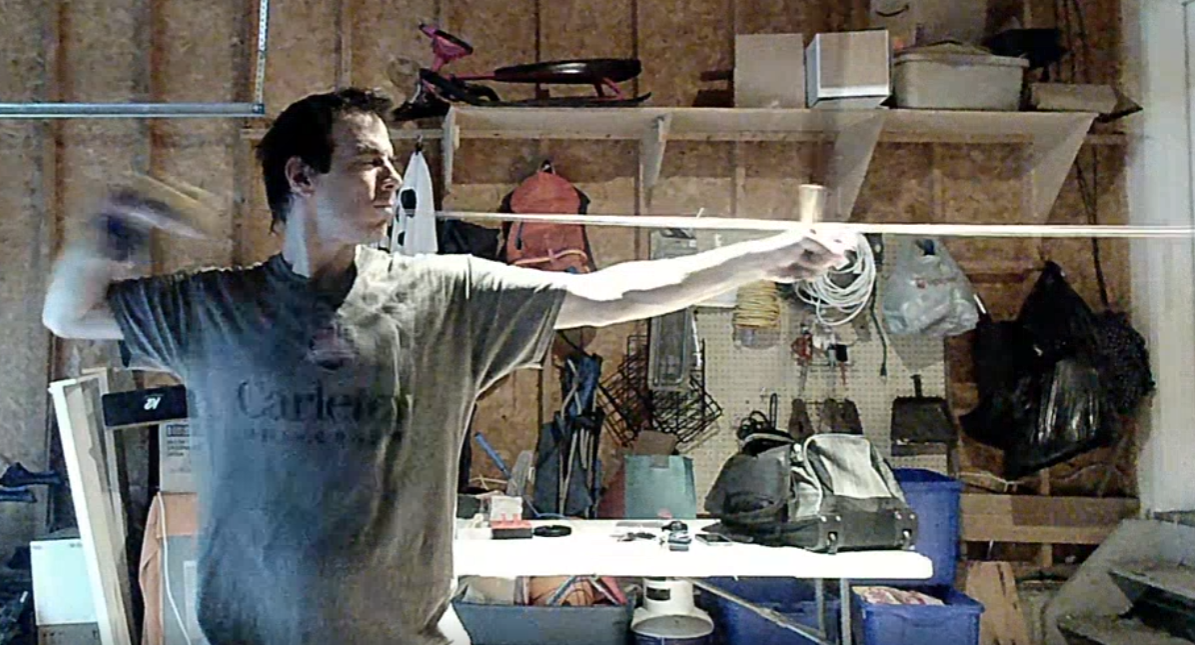
Today I got full YUGAERI and still hit myself. It was a lighter slap than usual, but still there. And that is useful information. Watching the video, (and given my lame refresh rate) it appears as though the bow begins the rotation immediately. I suspect that I'm still getting hit because I'm pushing my chest out into the draw at some point or perhaps not keeping my shoulders forward enough.
Here is the best frame I can get after HANARE:
In the next frame YUGAERI is already at 50% and then all the way around the frame after that. You can even see a ripple in my shirt where the string hits.
A high speed camera would be nice. But I work with what I have.
Which brings me to the original point of this; raising higher during UCHIOKOSHI.
This is far from new advice. In the past though, it wasn't obvious how it was helping. Here is where recording myself really helps. During practice, especially during DAISAN and into KAI with an arrow knocked, I'm looking at the target. It isn't really obvious what is changing. And a lot of things aren't the same with a GOMUYUMI or during SUBIKI where I might be able to observe a bit more.
The other problem is that raising the bow higher, on it's own doesn't offset the damage caused by extending too far during DAISAN. In fact, in some ways, it exacerbates that problem. The higher you raise the bow during DAISAN, those closer it is to your body when you start drawing into full KAI. You gain downward space to draw, so you can make the draw look better. But if I don't have the space outward from my body, I seem to end up literally "inside of the bow".
Which brings me back to posture. Mine has always sucked. But I think it encourages me to lean into the draw.
I will note, that frame also points out a few additional things to work on. My YUNDE has crept up a bit at the shoulder and my arrow was not straight.
Either way, progress is being made.
Comments
Post a Comment